
After a parking lot accident in Hutchinson, protect your safety, check for injuries, call for help when needed, exchange information, and document the scene before vehicles or surrounding conditions change. Photograph vehicle positions, damage, signs, pavement markings, sight obstructions, and nearby cameras. Report the crash to your insurer, seek medical care for new symptoms, and avoid guessing about fault.
Melinda Young Law helps people injured in Hutchinson and nearby Kansas communities understand what evidence matters, which insurance coverage may apply, and whether a driver, vehicle owner, employer, business, property owner, or another party may share responsibility. Parking lot claims can become disputed when both vehicles were moving, a pedestrian was involved, an unattended vehicle was damaged, or surveillance footage may be erased.
When you are facing challenges you never expected, Melinda Young is here to help. She will work with you to build a strong case right away. Your main focus should be on your health and well-being. Let us focus on getting you the best results possible.
Fighting for You.
Why Parking Lot Accidents Are Often Disputed 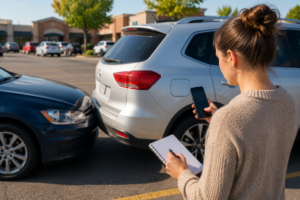
Parking lots place drivers, pedestrians, shopping carts, delivery vehicles, bicycles, and people using mobility devices in the same confined space. Drivers may back from opposite rows, turn around parked vehicles, cross marked spaces, or watch for an open space instead of the travel lane.
One driver may say that both vehicles backed at the same time. Another may claim that a pedestrian stepped from between parked cars. A business may have video, but the recording may not be kept for long.
Common parking lot accidents include:
- Two vehicles backing into each other
- A driver pulling from a parking space into an active travel lane
- A vehicle striking a pedestrian near an entrance
- A crash near a stop sign, crosswalk, cart corral, or loading area
- A collision involving a delivery vehicle or work vehicle
- A fall caused by broken pavement, poor lighting, ice, or a damaged curb
Parking lot claims may depend on details that disappear quickly. Preserve photographs, video, witness information, and vehicle damage before the evidence changes.
Step 1: Stop, Check for Injuries, and Make the Area Safer
Stop after the accident and check yourself, your passengers, the other driver, and nearby pedestrians for injuries. Call 911 when someone may be hurt, a driver leaves, traffic is blocked, impairment is suspected, or the situation feels unsafe.
Kansas law requires a driver involved in an accident that causes injury, death, or damage to an attended vehicle or other attended property to stop and remain at the scene until the driver provides the required information and reasonable assistance. Drivers generally must provide identifying, vehicle, license, and insurance information.
If you strike an unattended vehicle or other unattended property, Kansas law requires you to stop and either locate the owner or leave the required written information in a visible place. You must also notify the nearest authorized police authority without unnecessary delay.
Kansas law also requires an immediate police report when a person is injured or killed, apparent property damage is $1,000 or more, or the required information cannot be received by the people involved.
Move vehicles out of an active lane when it is safe and lawful. Before moving them, take wide photographs showing where each vehicle stopped. A police report may identify the drivers, record statements, and document visible conditions.
Read the firm’s guide about Kansas police reports here:
https://melindayounglaw.com/do-you-need-a-police-report-to-file-a-car-accident-claim-in-kansas/
Melinda is an asset to the city of Hutchinson and its legal community. I know she treats her clients with compassion and professionalism. It's a privilege to provide her an endorsement.
Ethan

Nicholas
Gabriel
Step 2: Exchange Complete Information
Collect the following information from every involved driver:
- Full name
- Address and phone number
- Driver’s license information
- License plate number
- Vehicle make, model, color, and year
- Insurance company and policy number
- Vehicle owner’s name when the driver does not own the vehicle
- Employer information when the driver was working
Take a photograph of the insurance card and driver’s license when the other person agrees. Do not rely on a verbal promise that the other driver will pay later. Keep the conversation calm and factual. Do not argue, accept blame, apologize for causing the crash, or speculate about what you failed to see.
If the other person refuses to exchange information, becomes aggressive, or appears impaired, contact law enforcement and remain in a safe location.
Step 3: Photograph the Entire Scene
Close photographs of bumper damage are not enough. Parking lot liability often depends on where each vehicle was traveling, which direction each vehicle faced, and what each person could see.
Photograph or record:
- The full parking row and travel lane
- Vehicle positions and directions of travel
- Damage to every involved vehicle
- Stop signs, arrows, crosswalks, curbs, and painted lines
- Store entrances, loading zones, drive-through lanes, and cart corrals
- Landscaping, parked trucks, signs, or structures that blocked visibility
- Debris, broken lights, pavement conditions, ice, water, and visible injuries
- Weather, lighting, and traffic conditions
- Nearby security cameras and doorbell cameras
Take both wide and close photographs. Include landmarks that show where the accident occurred. Save the original files and avoid editing or adding filters.
Common Mistakes in a Personal Injury Claim Choosing a Car Accident AttorneyRelated Videos
Step 4: Identify Witnesses and Cameras
Ask shoppers, employees, passengers, delivery drivers, and nearby residents for names and contact information. A neutral witness may help establish whether a vehicle was stopped, who entered the lane first, whether a driver used a phone, or whether a pedestrian was visible.
Look for exterior cameras on stores, banks, medical offices, apartment buildings, gas stations, and nearby properties. Tell a manager that an accident occurred and ask that relevant footage be preserved. Obtain the manager’s name, note the date and time of your request, and follow up in writing.
A written preservation request should identify the date, approximate time, location, and camera angle that may have recorded the accident. Businesses often record over video, so a prompt request may protect evidence that cannot be recreated later.
Step 5: Seek Medical Care for New Symptoms
Low-speed crashes can still cause head, neck, back, shoulder, knee, and soft-tissue injuries. Pedestrians may suffer serious harm even when a vehicle was moving slowly.
Seek emergency care for severe pain, confusion, weakness, numbness, breathing problems, loss of consciousness, heavy bleeding, or other urgent symptoms. Arrange a medical evaluation when pain, stiffness, dizziness, headaches, limited movement, memory problems, or sleep problems appear later.
Tell the medical provider how the accident occurred and when each symptom began. Follow treatment instructions and save appointment records, bills, prescriptions, work restrictions, and mileage records related to medical care.
Read more about medical care after an accident here:
https://melindayounglaw.com/the-importance-of-seeking-immediate-medical-attention-after-an-accident/
Step 6: Report the Accident Without Guessing
Notify your automobile insurer within the time required by your policy. Provide accurate information, but do not guess about speed, distance, injuries, or fault. You may state that you do not know an answer or that your medical evaluation is continuing.
Kansas motor vehicle liability policies generally must include personal injury protection benefits for the named insured, qualifying household relatives, drivers, passengers, and certain pedestrians struck by the insured vehicle. Coverage depends on the policy, statutory requirements, exclusions, and the facts of the accident.
You may also have a liability claim against a careless driver. When a dangerous property condition contributed to the accident, the investigation may include a property owner, tenant, management company, snow or ice removal contractor, maintenance contractor, or another business.
Use care before giving a recorded statement to another insurer or signing a broad medical authorization. Do not sign a release until you understand which claims, injuries, and parties it covers.
How Fault Is Evaluated in Kansas
Parking lot fault is not decided by a single rule that the backing driver is always responsible or that the vehicle in the wider lane always has the right of way. Investigators may consider:
- Vehicle movement and direction
- Right-of-way rules
- Speed for the conditions
- Driver lookout and attention
- Turn signals and warning lights
- Visibility and sight obstructions
- Stop signs and pavement markings
- Witness accounts
- Surveillance footage
- Vehicle damage patterns
- Phone records or other evidence of distraction
Kansas follows comparative negligence. You may recover damages when your negligence is less than the causal negligence of the party or parties against whom you make the claim. Your recovery is reduced by your percentage of fault.
For example, one driver may back without checking while another driver travels too quickly through the lane. Both actions may be evaluated.
Read the firm’s guide to Kansas comparative negligence here:
https://melindayounglaw.com/understanding-comparative-negligence-in-kansas/
Who May Be Responsible for a Parking Lot Accident?
The other driver may be responsible for failing to yield, backing without a clear view, driving too fast for the setting, using a phone, ignoring a sign, or failing to watch for pedestrians.
A vehicle owner may become relevant when someone else was driving the vehicle. An employer may become relevant when the driver was performing work duties at the time of the accident.
A property-related claim may depend on who controlled the parking area, how the hazard developed, how long it existed, whether the responsible party knew or should have known about it, and whether reasonable steps were taken to correct or warn about it.
Consider this example: A driver backs from a parking space while a delivery van blocks the view. Another driver cuts diagonally across empty spaces instead of using the marked travel lane. Video and vehicle damage may show that both drivers contributed. If the van was parked in a prohibited area as part of a business delivery practice, the investigation may extend beyond the two drivers.
What Compensation May Be Available?
The compensation available in your claim depends on your injuries, the evidence, insurance coverage, applicable law, and any percentage of fault assigned to you. A supported claim may include:
- Medical treatment and reasonably supported future care
- Lost wages and reduced earning ability
- Vehicle repair or replacement
- Towing and rental costs
- Damaged personal property
- Pain, physical limitations, and loss of normal activities
- Other documented accident-related expenses
Kansas generally applies a two-year limitation period to many personal injury actions. Exceptions and different deadlines may apply, including claims involving government entities, minors, or other special circumstances. Waiting can also make video, witness accounts, vehicle evidence, and property conditions harder to preserve.
Read more about Kansas filing deadlines here:
How a Hutchinson Car Accident Lawyer Can Help
A lawyer can inspect the scene, request surveillance footage, locate witnesses, review vehicle damage, identify insurance coverage, collect medical and wage records, and respond to arguments that you caused part or all of the accident.
A Kansas car accident lawyer can also communicate with insurers and evaluate a proposed settlement before you release your claims. No attorney can promise a particular result. Legal representation focuses on building a documented account of what happened and explaining the options supported by the evidence.
Learn more about Kansas car accident representation here:
https://melindayounglaw.com/kansas-car-accident-lawyers/
Get Help After a Hutchinson Parking Lot Accident
A parking lot accident can leave you managing medical appointments, repair estimates, missed work, and several insurance calls at once. Melinda Young Law has a Hutchinson office and offers free consultations for Kansas personal injury matters.
Call or text 620-501-8080 to discuss what happened, which evidence should be preserved, and what claims may apply. You may also use the firm’s contact page:
https://melindayounglaw.com/contact/
Melinda Young Law serves clients in Hutchinson and nearby Kansas communities.
This article is for informational purposes only and is not legal advice. Every case is different. Consult an attorney about your specific situation.